
Renter Friendly
How to Hang Pictures Without Nails: What Sticks, and What Falls
This post contains affiliate links. As an Amazon Associate we earn from qualifying purchases, at no extra cost to you.
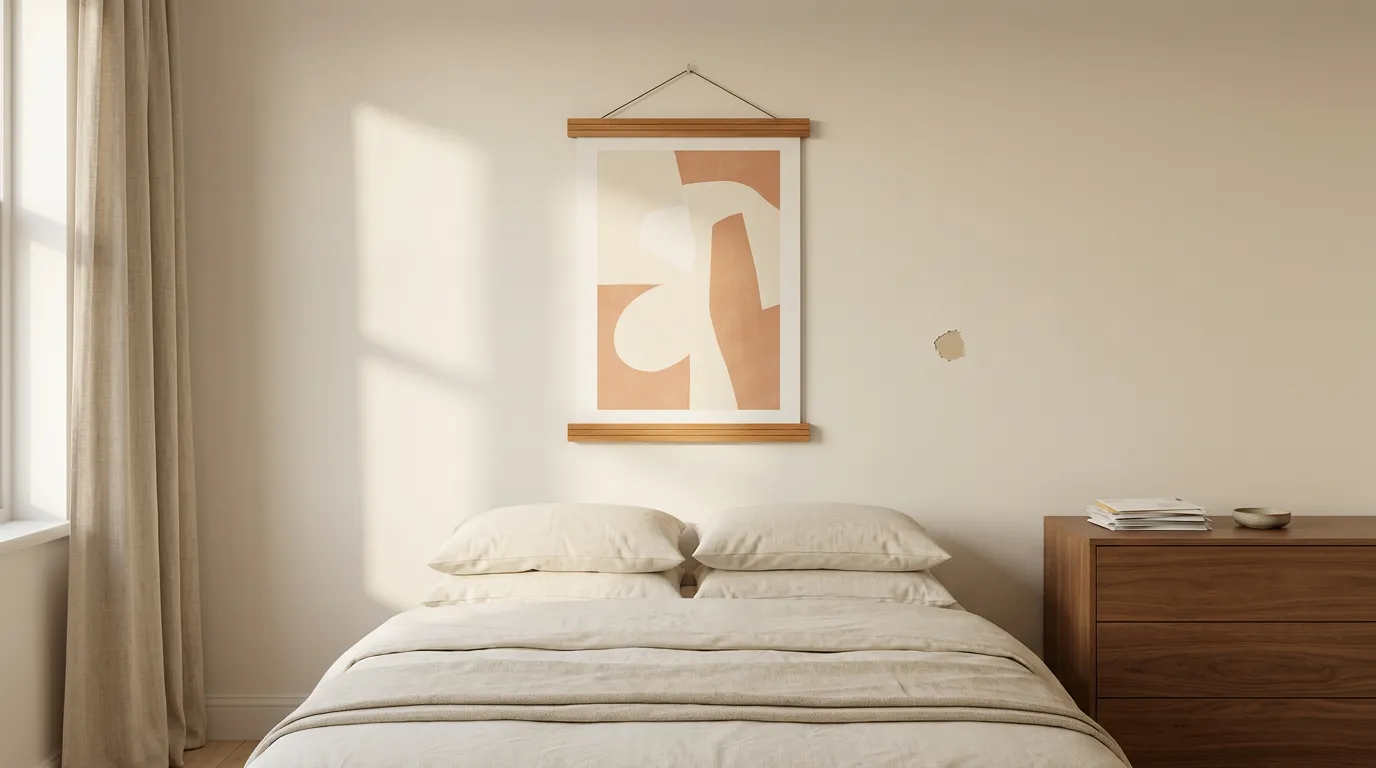
Most advice on how to hang pictures without nails is a list of cute ideas, when the thing you actually need is a straight answer about weight. Your lease says no holes. Your wall is doing nothing. And somewhere in a closet there's a print you bought eight months ago that has never once been on a wall.
Can you hang pictures without nails? Yes, up to a point, and the point is weight. Picture hanging strips carry a framed piece up to about 15 pounds on a smooth painted wall, adhesive hooks carry roughly 13 pounds at a single point, and neither works on textured walls, brick, or wallpaper. So hang paper where you'd normally hang glass, split anything heavier across two anchors, and leave the rest on the floor.
What follows is five renter-friendly ways to fill a wall with nothing but adhesive and a bit of patience. Each one comes with the part most no drill wall decor posts leave out: what it holds, and where it quietly fails.
What can you hang on a wall without drilling?
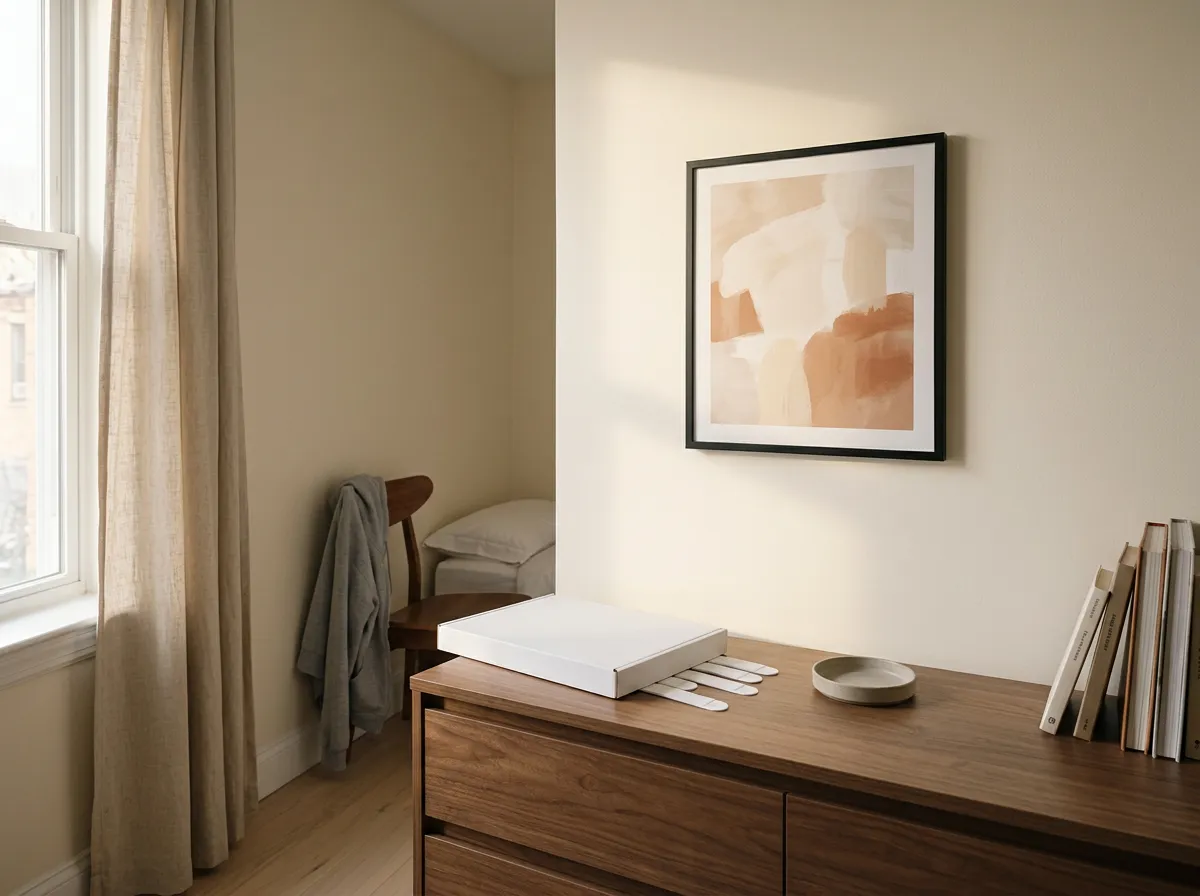
Anything under about 15 pounds, on a smooth painted wall, that you're willing to hang once and leave alone. That's the honest boundary. Picture hanging strips are two interlocking halves, one on the frame and one on the wall, and they pull apart on purpose when you move out.
The rating is the easy part. The wall is where people get burned.
- Smooth painted drywall is the only reliable surface. Orange peel and knockdown texture give the adhesive maybe a third of the contact it needs, so it holds for a week and lets go in the night
- Brick, concrete, and wallpaper are a no. On wallpaper the strip holds fine. The paper is what comes off the wall
- Fresh paint needs about a week. Paint keeps curing after it looks dry, and a strip pressed onto week-old paint takes the color with it later
- Clean with rubbing alcohol, not a household spray. Cleaners leave a residue film, and that film is what the strip ends up gripping
Pick this if you have frames already sitting on the floor. A mixed pack of large and medium pairs is the useful buy, because a gallery wall is mostly small frames with two bigger anchors, and a box of one size runs out halfway through.
- Press each half onto the frame and the wall for 30 seconds, hard, with your thumb
- Wait an hour before you hang anything. This step is the one everyone skips
- To take it down, pull the white tab straight down along the wall, slowly, until it releases
Level it with your phone, not your eye. Adhesive gives you one attempt at the placement, and a crooked frame is the sort of thing you stop seeing after a week and then hate in a photo.
Our picks
Similar finds on Amazon
How do you hang heavy wall decor without drilling?
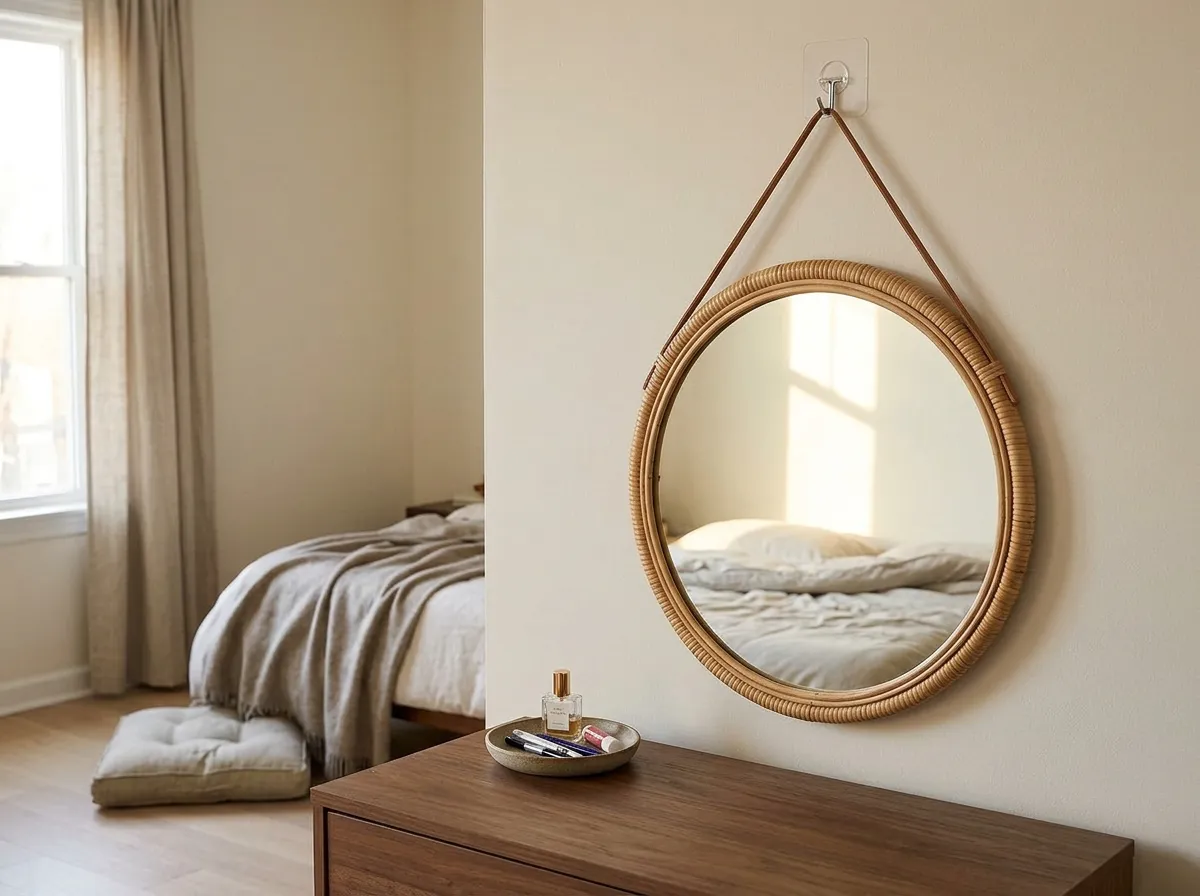
You don't make the adhesive stronger. You make the load smaller and split it across two points. A good clear hook is rated around 13 pounds, and that number assumes a clean smooth surface, room temperature, and a weight hanging straight down.
Three things quietly eat that rating, and they're worth knowing before you trust a hook with something breakable.
- Angle. Weight pulling outward from the wall, like a heavy round mirror that sits proud, peels the adhesive instead of loading it flat
- Heat. A wall above a radiator or in afternoon sun softens the glue. Bathrooms do the same thing with steam
- Time. Adhesive creeps. Something at the very top of the rating is fine in week one and sagging by month three, so treat the number as a ceiling you stay well under
Pick this if you keep running out of hooks in the middle of a project. Clear ones disappear against a pale wall, which counts when the hook is holding a wreath or a hat and stays visible from the side of the room.
Once it's heavy, two hooks beat one. A light rattan mirror is fine on a single hook, but split real weight across a pair set a hand's width apart and each carries half. It also stops the rotating that makes a single-hook frame look crooked within a month.
And hang the heavy thing low. A mirror at chest height that lets go drops onto a dresser. The same mirror above a bed drops onto a person. Renters get told to hang art high, but with adhesive, low is the safer instinct.
Our picks
Similar finds on Amazon
How do you hang art without nails or frames?
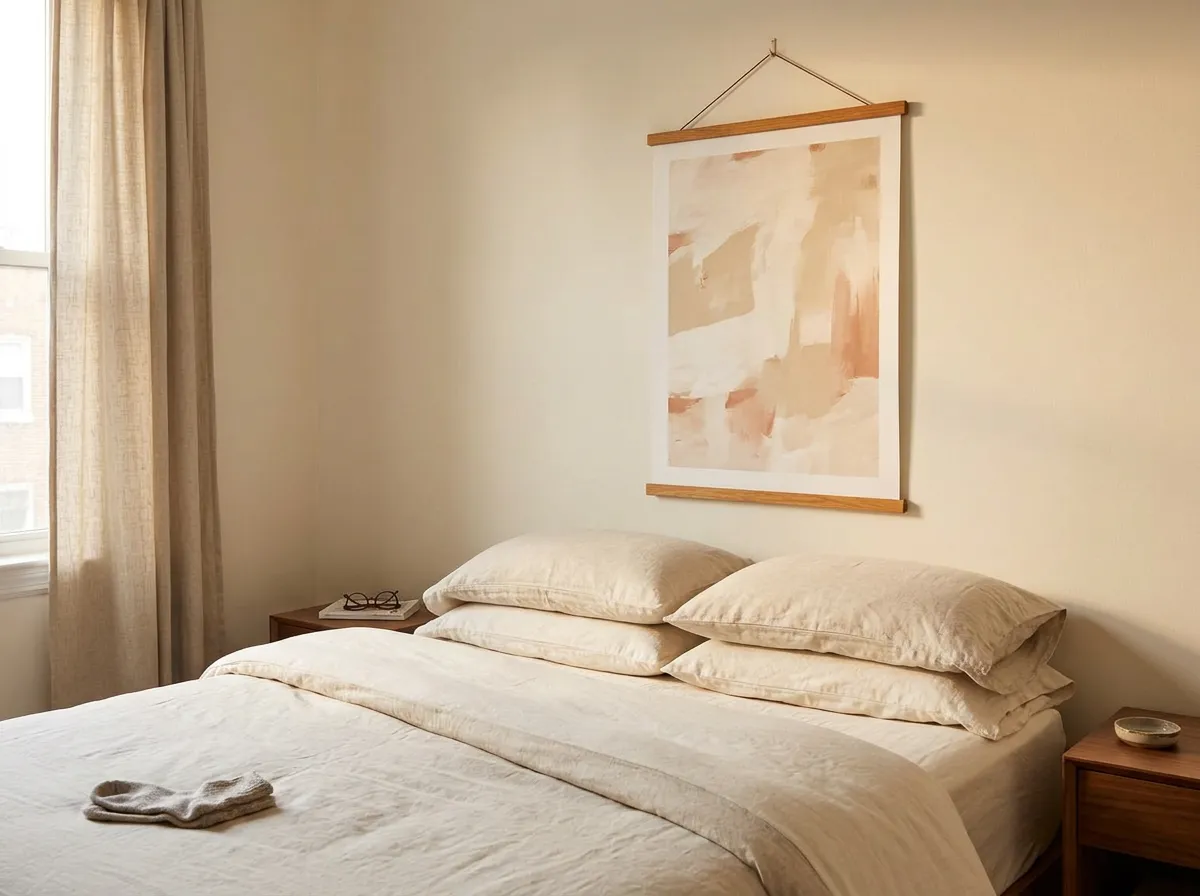
Drop the frame. A framed 18 by 24 print is mostly glass and MDF, and the glass is the reason it's too heavy for adhesive.
A magnetic poster hanger is two thin wood rails that clamp the paper top and bottom, so the same print goes on the wall at a fraction of the weight, hanging off one small hook.
This is the single best trick in renting, and it barely gets mentioned.
- No glass means no risk. If a framed piece does come down it takes the wall, the floor, and your evening with it. Paper just lands
- Swapping is 20 seconds. The rails open, the print slides out, a new one slides in. Same hanger, new wall, every few months
- Big reads better than many. One large print does more for a bare wall than six small frames, and it needs one anchor instead of six
- Warm wood over black hardware in a room with any wood in it already, so the hanger reads as part of the room
Pick this if your wall is big and empty and you keep putting it off. The blank wall problem is almost always a scale problem. Small art on a large wall looks like a mistake, and buying big framed art is expensive and heavy. Paper solves both at once.
Where it goes: above a dresser, above the sofa, or centered on the one wall you see from the doorway. Leave a hand's width of clear wall around it, since paper needs the space around it to read as deliberate.
One caution. Paper curls in a steamy bathroom and fades in direct sun, so keep it out of both and it stays flat for years.
Our picks
Similar finds on Amazon
What do you actually put in the hanger?
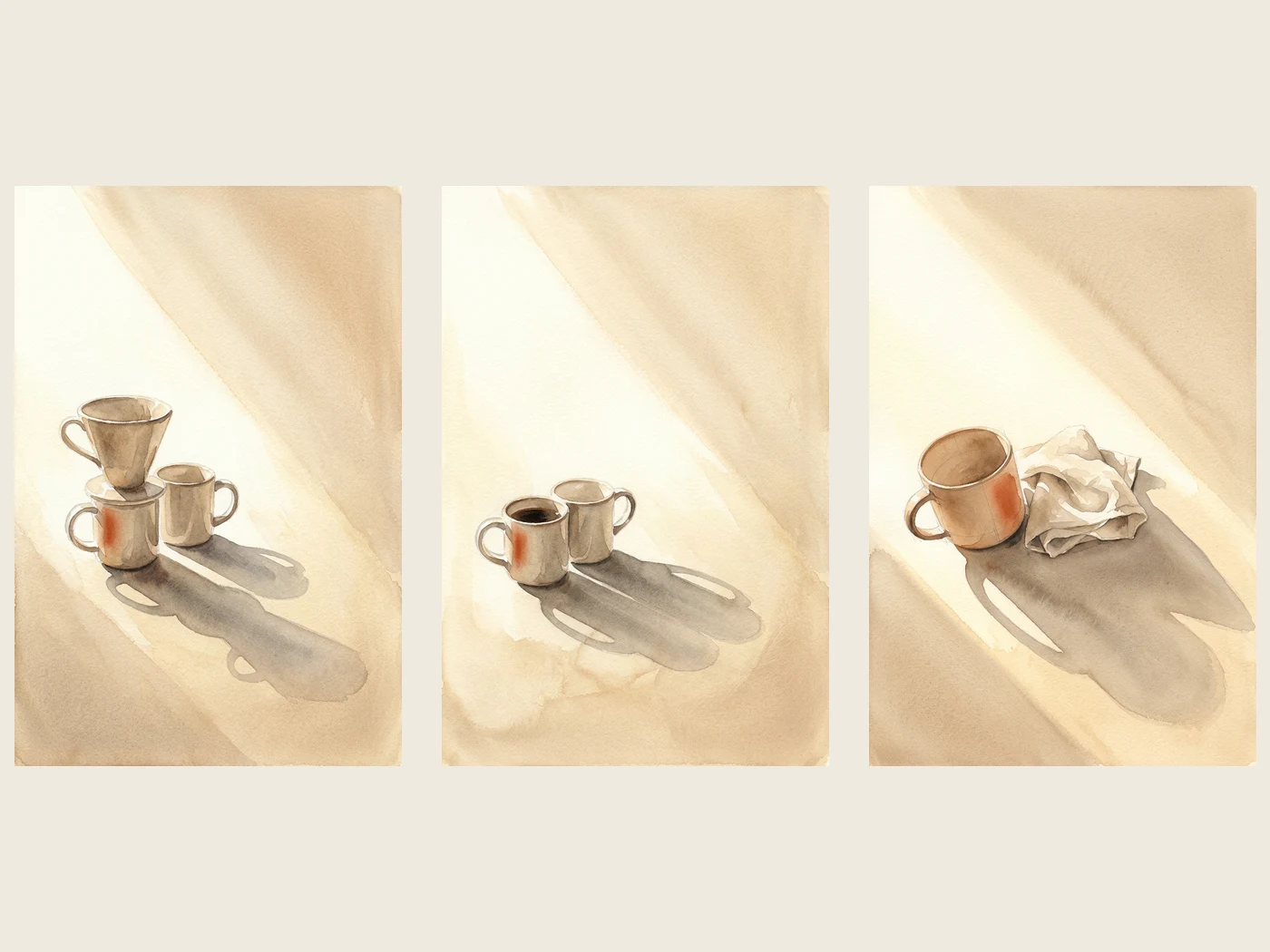
The hanger is the easy part. The art is where people stall. You get the rails, you look at prints for an hour, everything is either forgettable or costs more than the hanger did, and the wall stays bare another month.
Two things make this easier than it looks.
- A set of three beats one big piece on most rental walls, because three narrow prints fit the spaces a sofa or a counter actually leaves you
- Match the ratio, not the size. A 2:3 print scales cleanly to 12x18, 16x24 and 20x30, so one file covers whatever hanger you end up with
- Hang them at one height, bottom edges level, a hand's width apart. Uneven spacing is what makes a wall read as cluttered rather than considered
- Print on matte, not glossy. Glossy fights the light and shows every fingerprint, and it is the fastest way to make paper look cheap
The set above is ours. Three pieces of the same morning: the light arrives, it spreads, it drops again. Warm neutrals, one soft terracotta note, nothing that fights a room you already decorated.
Why a set works over a coffee counter specifically. The wall there is usually wide and short, cut into by cabinets or a shelf. One large print rarely fits that shape. Three narrow ones do, and they carry a horizontal run the way the wall already wants to go.
Sizing it without measuring twice. Hold the run to roughly two thirds of the furniture below it. Above a counter that usually lands at three 12x18 prints; above a sofa, three 16x24.
Similar finds on Amazon
Can you put up a shelf without drilling?
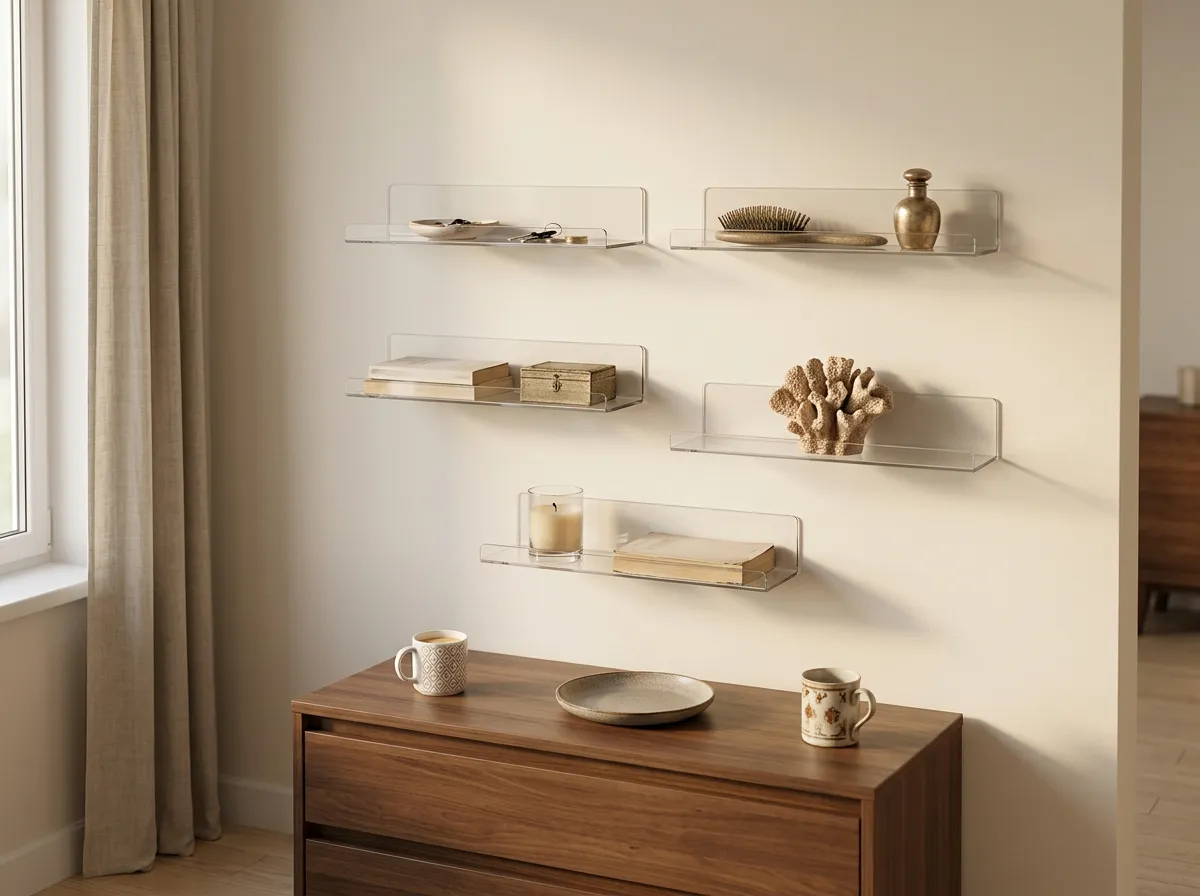
Yes, for light objects, and only if you're honest about what light means. Adhesive acrylic shelves hold a candle, a small stack of paperbacks, a photo, a few skincare bottles. They do not hold a plant in a ceramic pot, a speaker, or anything you'd be upset to sweep up.
Clear acrylic is the right material for a rental, and being cheap to replace is the least of the reasons.
- A clear shelf disappears, so the object floats. In a small room, a wall of visible brackets makes the walls feel closer than they are
- Load sits at the back, near the wall. Weight at the front edge levers the adhesive off, which is how these fail when they fail
- Stagger four instead of stacking them in a column. Two high, two low, offset, so the wall reads as composition
- Skip the bathroom. Steam plus adhesive is a losing bet, no matter what the packaging says
Pick this if you want a surface but the room has no floor left. That's the real small-space problem. There's no room for a side table, and every flat surface you own is already full, so the only space left is vertical.
Give it a full day before you load it. The adhesive reaches its real strength overnight, and a shelf loaded an hour after it goes up is the shelf you'll find on the floor.
And keep them low over furniture. A shelf above a dresser or a desk has something underneath it to catch a fall. A shelf over a bed does not.
How do you change a wall without doing it all over again?
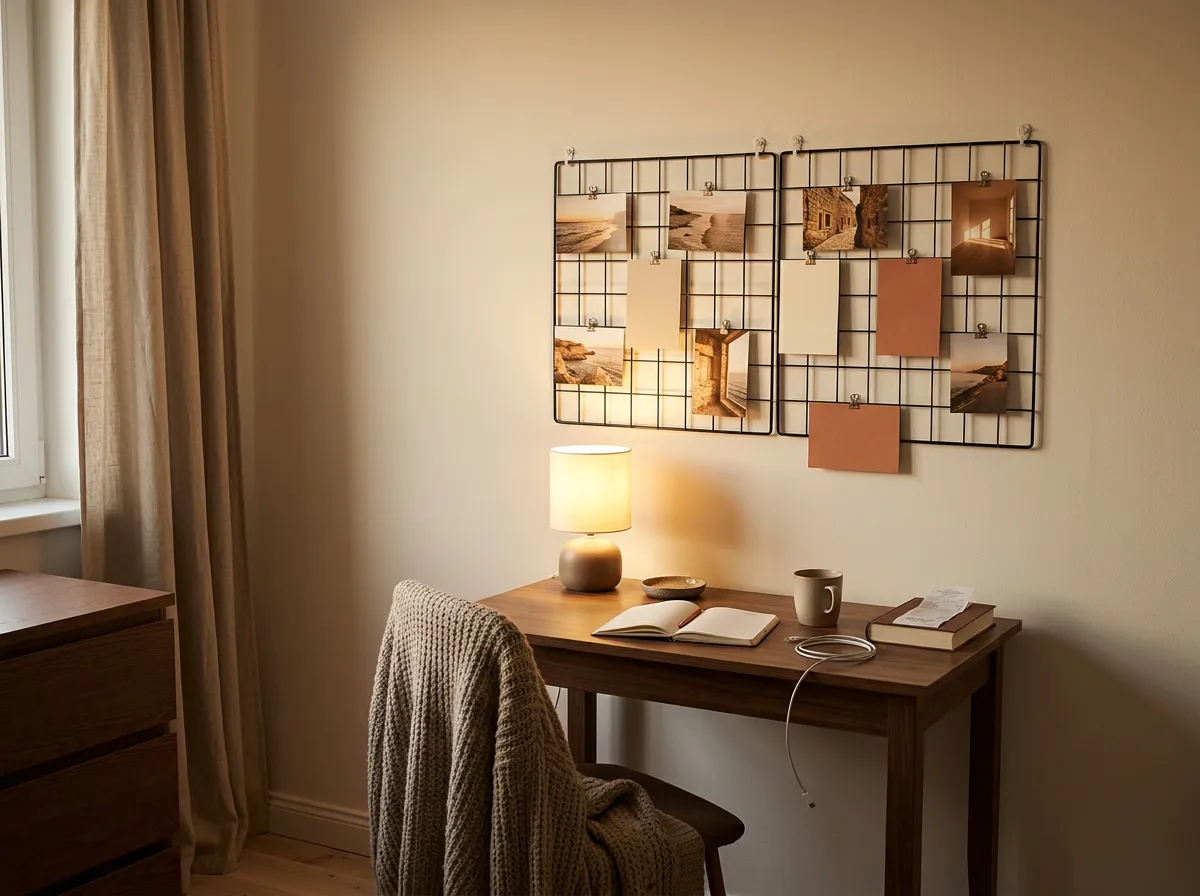
Hang the frame once and change what's inside it. A wire grid panel goes up on two hooks and then never moves again.
Photos, postcards, ticket stubs, and prints clip on and come off in seconds, so the wall changes every few months without the adhesive being touched a second time.
Every re-hang is another chance to peel paint, and the more times you go back to the same patch of rental wall, the worse the odds get.
- Two panels side by side read as one intentional block. A single small grid on a big wall looks like it's waiting for the rest of the set
- Clips over tape. Tape leaves marks on photos, and the point of a grid is that nothing is permanent
- Mix sizes on it. All 4 by 6 prints in a neat row turns into a spreadsheet. Overlap a few, leave a gap, let it look handled
- It also holds objects, so a small hook on the grid takes keys, headphones, or a hat, and the wall does two jobs
Pick this if you get restless. Some people put art up and leave it for five years. If you're the other kind, a fixed wall arrangement starts to feel stale by month three, and a grid gives you somewhere to put that impulse that costs nothing.
[Above a desk](/blog/desk-essentials) is the natural spot. It's the wall you look at most, the one that benefits most from changing, and a grid at eye level from a chair is the right height without any measuring.
Our picks
Similar finds on Amazon
Three things to skip, since they cause most of the damage renters get charged for: heavy mirrors on a single hook, adhesive anything on textured or papered walls, and peel-and-stick decals on a wall that has been painted more than once. All three come off with a layer of the wall attached.
If you do one thing this weekend, put up the big print. The wall you see from the doorway is the one your eye keeps landing on, and it's been empty since you moved in. The whole setup comes down in about ten minutes on the day you hand the keys back.
Walls sorted, the rest of the room is easier: here's how we'd handle renter-friendly living room finds and cozy bedroom lighting under the same no-holes rule.