
Renter Friendly
Small Bathroom Decor Ideas That Don't Need a Single Drill Hole
This post contains affiliate links. As an Amazon Associate we earn from qualifying purchases, at no extra cost to you.
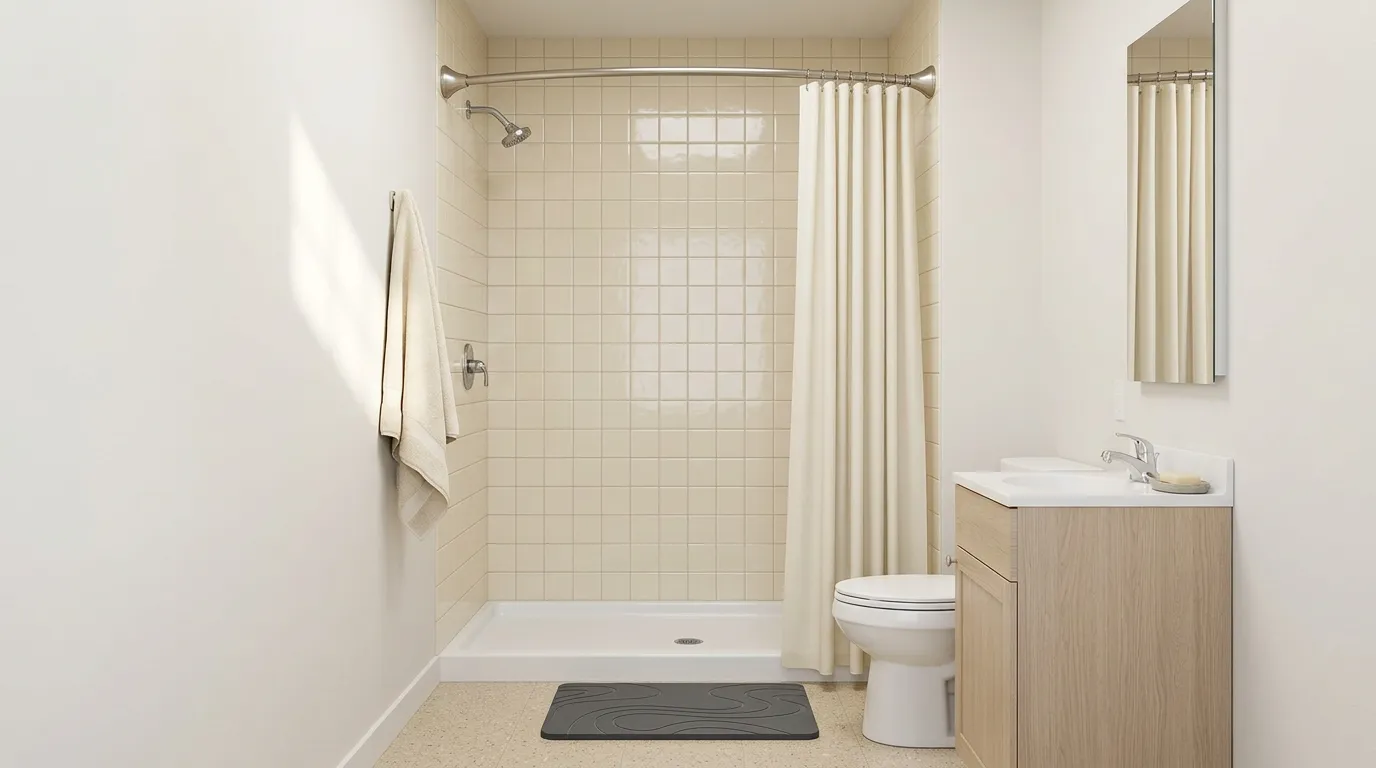
Most small bathroom decor ideas quietly assume you're allowed to change the tile. You're not. You rent, the floor is that speckled beige, the vanity came with the building, and the light bar over the mirror points four bulbs straight at your face.
How do you decorate a small bathroom you're not allowed to renovate? Work only on the things that aren't attached to the building: what the water comes out of, what hangs in the shower, what's on the floor, what sits on the vanity, and what stands beside the toilet. Every one of those unscrews, lifts out, or tensions into place. Every one moves out with you.
That's the whole approach here. No drill, no landlord conversation, no gambling with a deposit you'd like back.
Picture the room on a normal Tuesday. The curtain isn't sticking to your arm, the floor under your feet is dry, and the counter holds four things instead of eleven. That's a couple of weekends of small swaps.
What can you actually change in a rental bathroom?
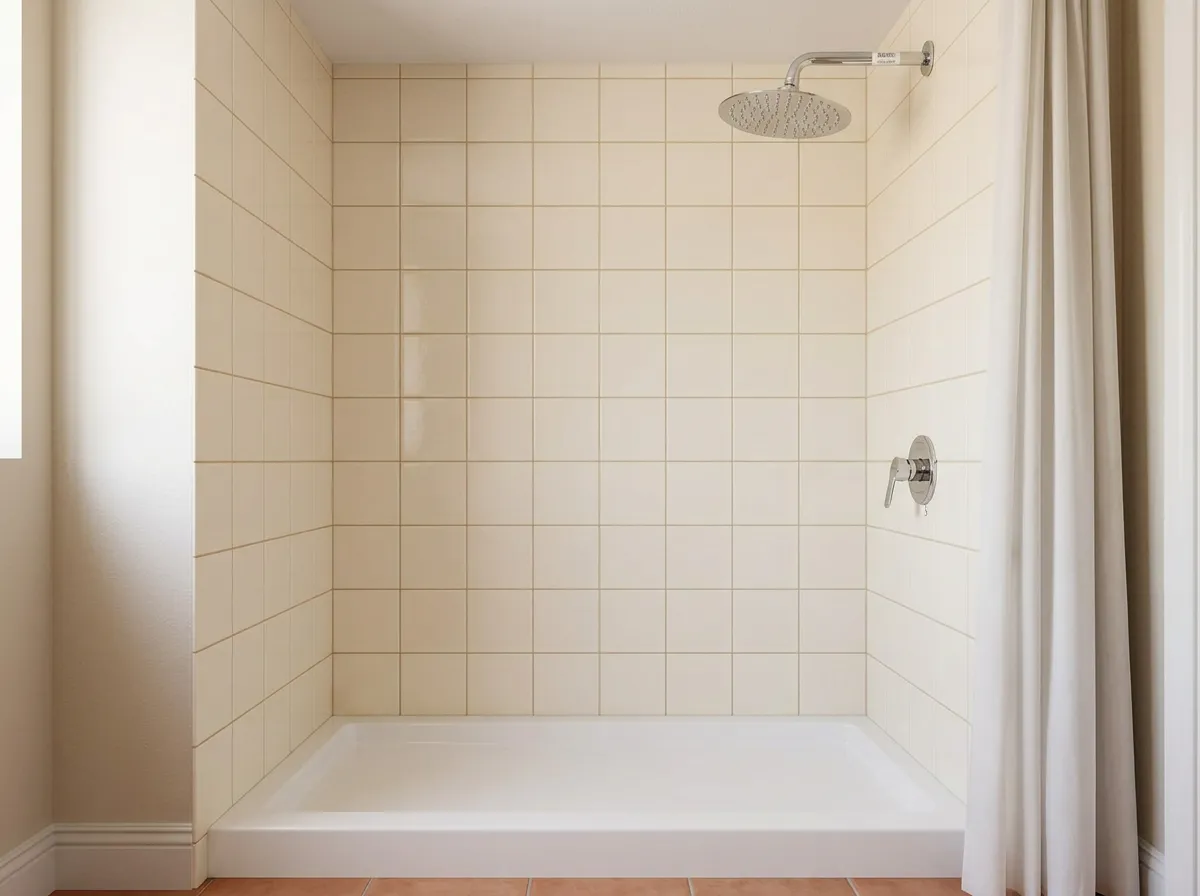
Anything that unscrews, tensions, or simply sits there. That list is shorter than a homeowner's and much longer than most renters assume, and it starts with the thing you touch twice a day.
Shower heads come off by hand. Grip the collar, turn it counter-clockwise, and it threads off a standard half-inch pipe. Wrap the threads with plumber's tape and spin the new one on. You'll be done before the kettle boils.
- Keep the old one. Box it, label it, shove it under the sink. On move-out day it goes back on and nobody ever knows
- Judge the spray face, not the finish. A wider face spreads the same pressure over more of you, which is what makes weak rental plumbing feel less weak
- Skip anything needing a plumber or a new shower arm. The second a swap involves the wall, it stops being reversible
What if the fitting is corroded? Leave it alone. A seized joint is the one case where forcing it turns a five-minute swap into a repair bill you'll be paying for.
Pick the ultra-thin NearMoon if your current head dribbles more than it sprays. The pressure-boosting face is built for exactly the tired low-flow plumbing that comes with an older rental, and the slim profile doesn't crowd an already tight shower.
What else on this list is genuinely reversible? More than you'd think. Curtain rods, caddies, floor mats, anything freestanding, and every single thing sitting on the counter. That's five zones without touching a wall once.
Why does the shower feel so tight if the stall is a normal size?
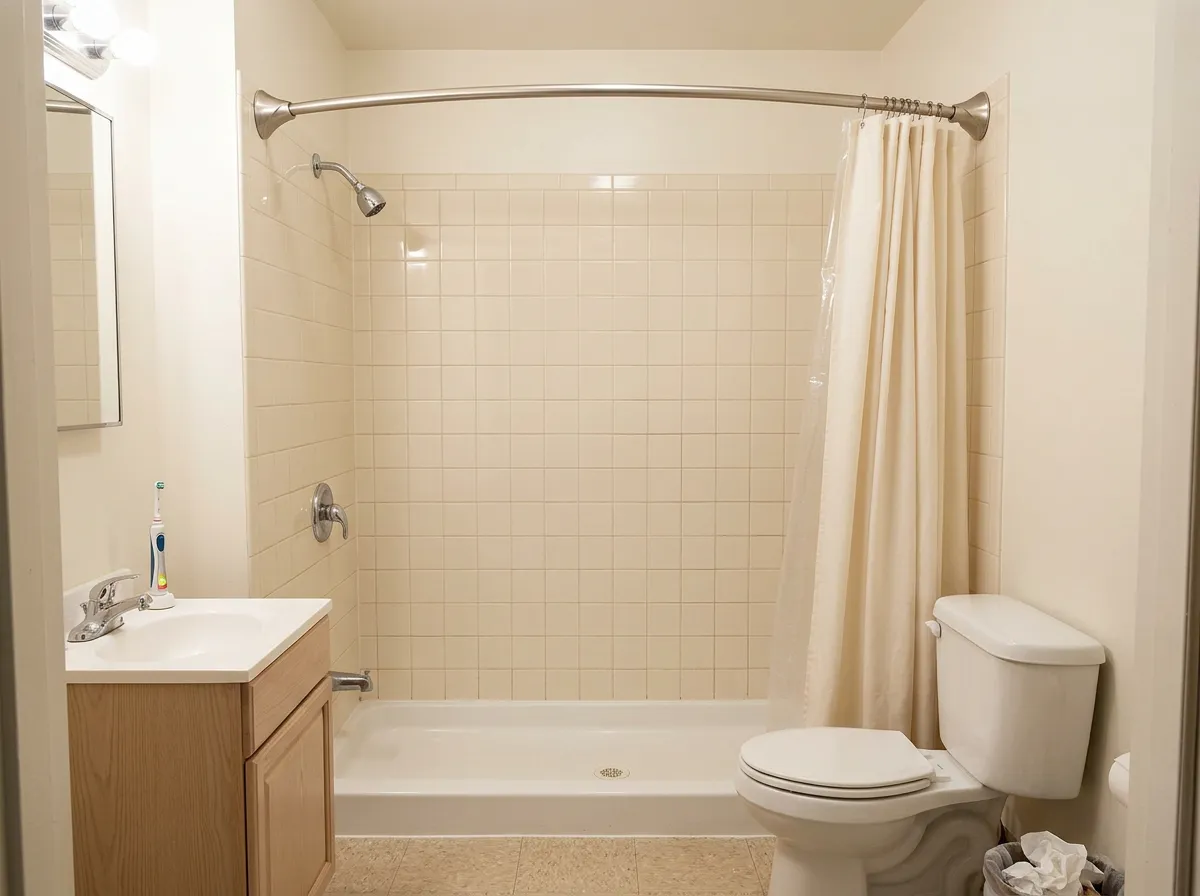
Because the curtain hangs straight down and leans in on you. A straight rod parks the curtain right at the edge of the stall, so every time you turn around, cold wet vinyl finds your shoulder.
A curved rod bows outward instead. Same stall, same tile, nothing touched. The curtain line just sits several inches further out, and that space lands exactly where your elbows already are.
- Tension, not screws, and check this before you buy. Most curved rods on Amazon ship with wall brackets and quietly expect you to drill. The tension versions wedge between the walls on a spring, so there's no bracket and nothing to patch later
- Measure wall to wall, not the opening. Rods list a range, and you want your number sitting near the middle of it. Tension slips at the far ends of the range
- Curtain and liner on the same hooks, liner tucked inside the stall. A liner hanging outside is how water ends up on your floor
Does it really make the room look bigger? It makes the shower read wider from the doorway, and in a small bathroom the doorway is the only view anyone gets.
Reach for a tension-mounted one if you want this to stay genuinely reversible. It grips between the two walls with no hardware left behind, and it comes down as fast as it went up.
Will tension hold on tile? On flat tile, yes, as long as both ends land on solid wall rather than on a bullnose edge or a strip of trim. Give it a firm downward tug before you trust it with a wet liner.
Where does the shampoo go when there's no niche?
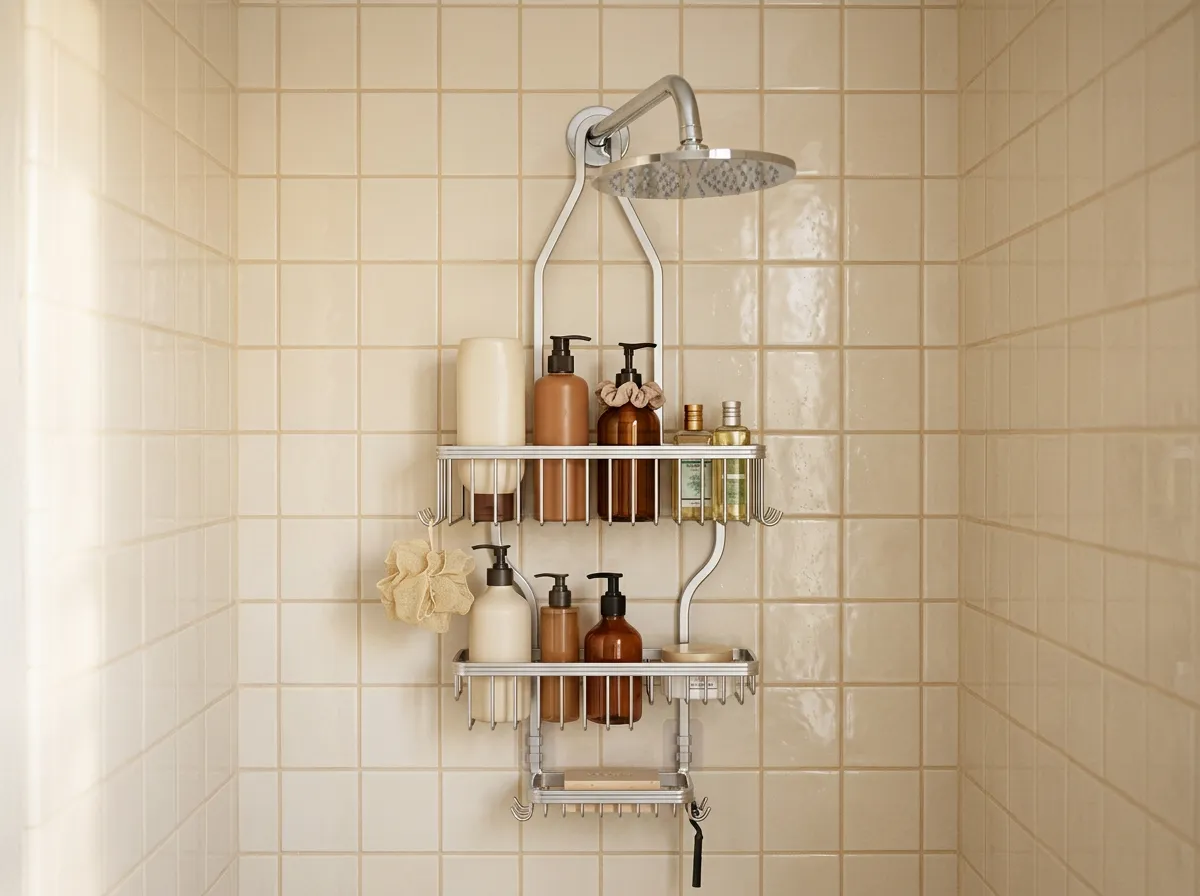
On something that hangs from the shower arm, never on something stuck to the tile. Suction cups fail in a wet room, and it isn't a quality problem. Heat and steam work the seal loose until the whole shelf lets go at six in the morning.
A hanging caddy has no seal to break. It sits on the neck of the shower arm, and the weight of your own bottles is what holds it still.
- All aluminium, no steel bolts. A caddy stays rustproof right up until one steel screw bleeds an orange streak down your grout
- Count your bottles honestly. Two people means shampoo, conditioner, body wash and a razor at minimum, and a single-tier caddy loses that fight by week two
- A raised lip on each shelf matters more than it sounds. Wet hands knock bottles sideways
Wall-mounted head with no neck to hang from? Then a corner tension pole is the fallback, though it does eat floor space. Try the hanging one first.
Go three-tier if the shower is shared. One tier per person plus a spare shelf sounds excessive right up until two sets of bottles are fighting over the same ledge.
Does a hanging caddy scratch the tile? It shouldn't, since nothing presses against the wall. If yours swings into the tile when the curtain moves, add a strip of clear bumper tape to the back edge.
Why is the bath mat still damp at bedtime?
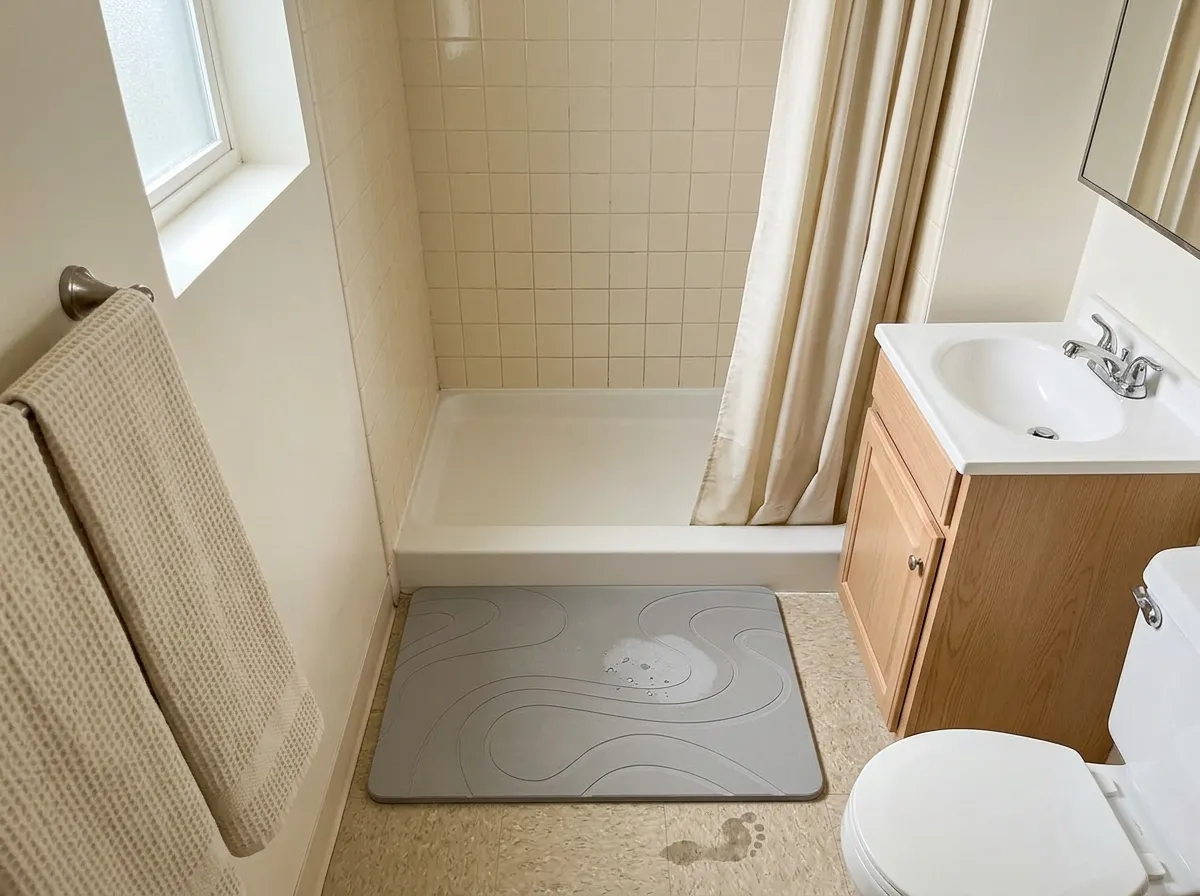
Because cloth holds water and a small bathroom has nowhere to dry it. No window, an extractor fan that's mostly ceremonial, and a mat that goes back down still damp from this morning.
That's where the smell comes from, by the way. Not the room. The mat.
- It never goes in the wash. When it stops drinking, you sand it lightly with the pad it ships with, and that's the entire maintenance routine
- It is hard. Genuinely hard, like standing on a paving slab. If you love sinking into something plush, this is the wrong swap and I'd rather say so now
- Get one with a grippy underside. Stone sliding on wet tile is a bad afternoon
Cold underfoot? In winter, yes. Keep a small washable runner by the sink for that and let the stone handle the spot where you step out.
Choose stone if your bathroom has no window, which describes most rental bathrooms. That's the situation where cloth simply never gets a chance to dry and the room starts smelling like a gym bag by Thursday.
How big should it be? Big enough for both feet side by side, and no bigger. An oversized mat in a small bathroom swallows the floor and undoes the space you were trying to gain.
One more thing worth knowing before you buy: these arrive cold and heavy, and they can crack if you drop one on a hard floor (tile being the obvious hazard here). Carry it flat and set it down gently. Treated with any care at all it'll outlast several cloth mats.
Our picks
Similar finds on Amazon
Can a small vanity look tidy without adding storage?
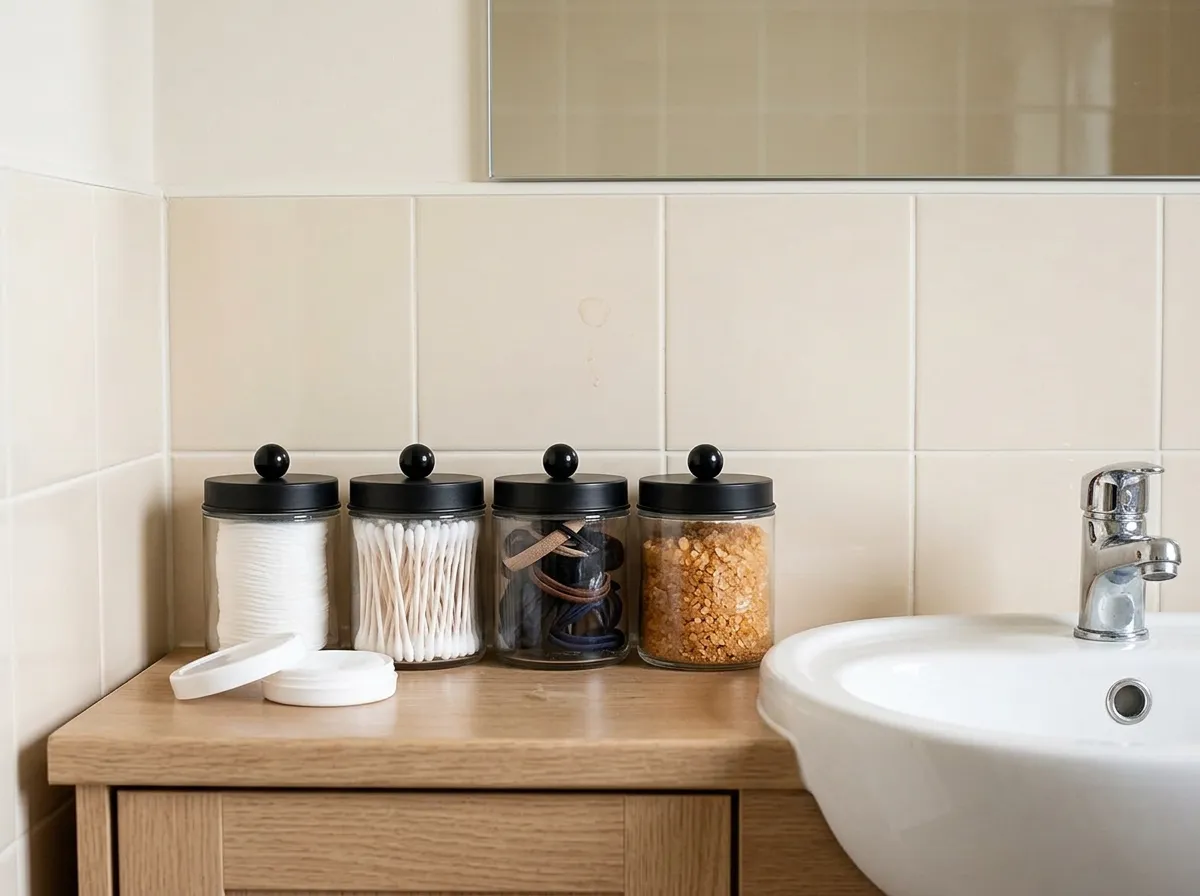
Yes, and it has almost nothing to do with storage. Small counters read messy because of packaging: seven brands, seven colors, seven fonts, all shouting at each other across two feet of laminate.
Decant the things you reach for daily into matching glass and the counter goes quiet. Same objects, same footprint, half the visual noise.
- Only decant what you use daily. Cotton buds, cotton pads, hair ties, bath salts. Everything else belongs behind a door
- Clear glass with metal lids stays calm. Amber and frosted sets tip into apothecary-shop territory fast
- Leave one stretch of counter completely empty. Emptiness is what makes a small surface read as deliberate
And that light bar over the mirror? You can't move it, but you can change what's in it. Warm 2700K bulbs instead of the cool white ones, and the room stops feeling like a dentist's waiting area. No product needed, any warm bulb in the right base works.
A set of four jars is the right number for most vanities. Two looks accidental, six turns your counter into a display case, and four covers the daily things without any of them touching each other.
What color works best in a small bathroom? Warm off-white if you're allowed to paint. If you're not, put the warmth in what you carry in: cream towels, wood, clear glass. Cool grey plus cool bulbs is what makes a small bathroom feel like a hospital corridor.
Where do the spare rolls go when you can't drill?
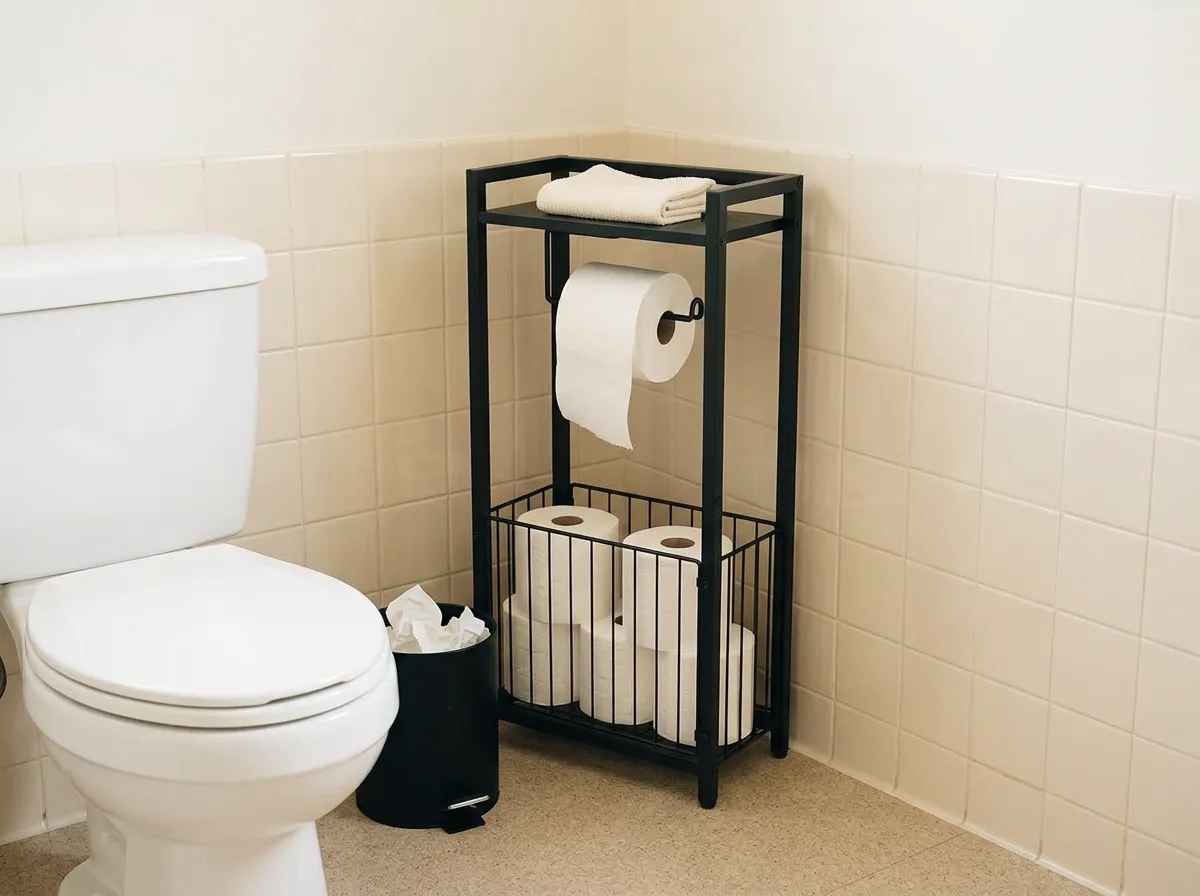
Standing up, in the dead gap beside the toilet. Every small bathroom has that eight or ten inch slot, and in most rentals it holds nothing except a scale nobody stands on.
A freestanding holder puts the working roll at hand height and stacks the spares below it. No bracket, no anchors, no filling holes with toothpaste the week you move out.
- Weighted base, or it tips. A light stand goes over the first time somebody grabs the roll in a hurry
- Measure the gap before you order. Most stands want around eight inches, and the toilet is rarely where you remember it being (measure from the tank, which sticks out further than the bowl)
- Skip the ones with a tiny top tray. That tray is exactly the right size for a phone to slide off into the toilet
Bathroom too narrow even for that? An over-the-door pocket organizer does the same job from the back of the door and costs you no floor at all.
Pick a stand with a closed lower shelf if the spare rolls will be visible from the doorway. Open stacking looks fine in a photo and looks like a supermarket shelf in a two-metre room.
Is a stand better than the bracket that's already there? Only if the bracket is in a stupid place, which in rentals it usually is. Leave the bracket where it is and put the stand where your arm goes.
If you only do one of these, make it the shower head. It costs you five minutes and no tools at all, and you'll feel the difference twice a day.
The rest can happen a weekend at a time. None of it is permanent, which is exactly the point. In a year the tile will still be beige, and it still won't be your problem.