
Apartment Living
Studio Apartment Ideas: 6 Ways to Zone One Room, No Drilling
This post contains affiliate links. As an Amazon Associate we earn from qualifying purchases, at no extra cost to you.
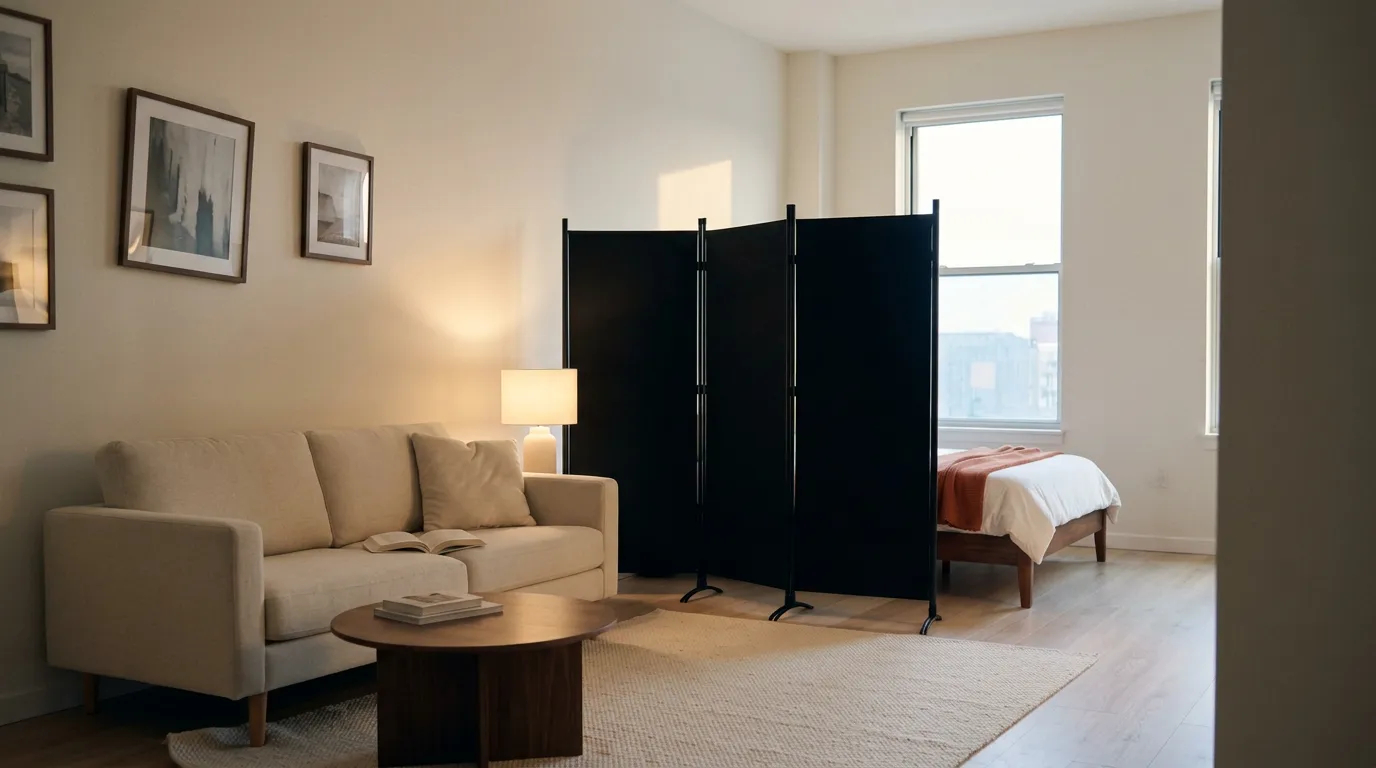
Most studio apartment ideas assume you can knock something through or bolt something up. You can't, so you end up with a bed, a sofa and a desk floating in one open room that reads as a bedroom no matter how you shuffle the furniture.
Short version: stop arranging furniture and start drawing edges. A studio needs three zones (sleep, living, work) and each one needs a visible boundary. A screen, a curtain and a piece of furniture with its back turned will do all three, and every one of them comes apart on moving day.
The problem isn't square footage. It's that your eye can see the bed from the sofa, so the whole room stays filed under bedroom and never feels like a place you would sit down in the evening.
Boundaries fix that, and they don't have to be tall or solid. A waist-high line your eye stops at does most of the work.
Here's the order to go in, starting with the boundary that changes the most for the least effort.
How do you divide a studio apartment without building a wall?
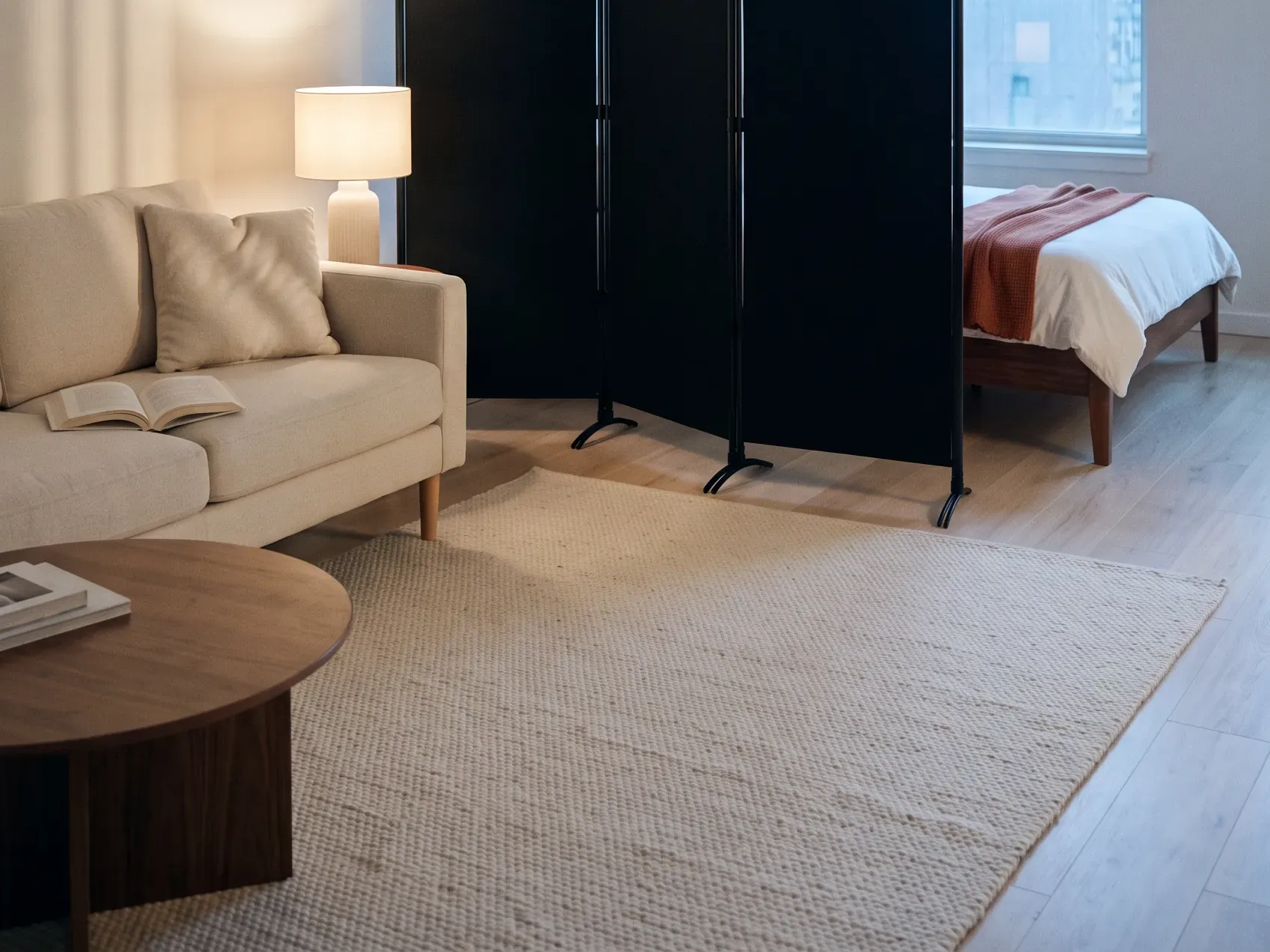
Put something between the bed and the rest of the room that your eye can't see past. That's the whole job. It doesn't need to reach the ceiling and it doesn't need to touch a wall.
A folding screen is the fastest version. It stands on its own, moves when you want the room open again, and folds flat behind a door when a guest is coming.
Screen or curtain? Depends on what's bothering you. A screen blocks the view. A curtain blocks the view and the light, which matters if your bed faces a window and your partner is up two hours before you are.
- Angle the screen slightly instead of squaring it to the wall. A straight line reads as a partition, an angle reads as a room.
- Leave a gap you can walk through, roughly a shoulder's width. A boundary you have to squeeze past gets moved within a week.
- For the curtain, a tension rod between two walls holds it without a single hole. Check the span first, since long runs sag in the middle.
How tall does the divider need to be? Taller than seated eye level, shorter than the ceiling. Around five feet is the sweet spot. It hides the bed from someone on the sofa but still lets light carry over the top, so the room never feels chopped in half.
Where does the living area start if there's no wall behind the sofa?
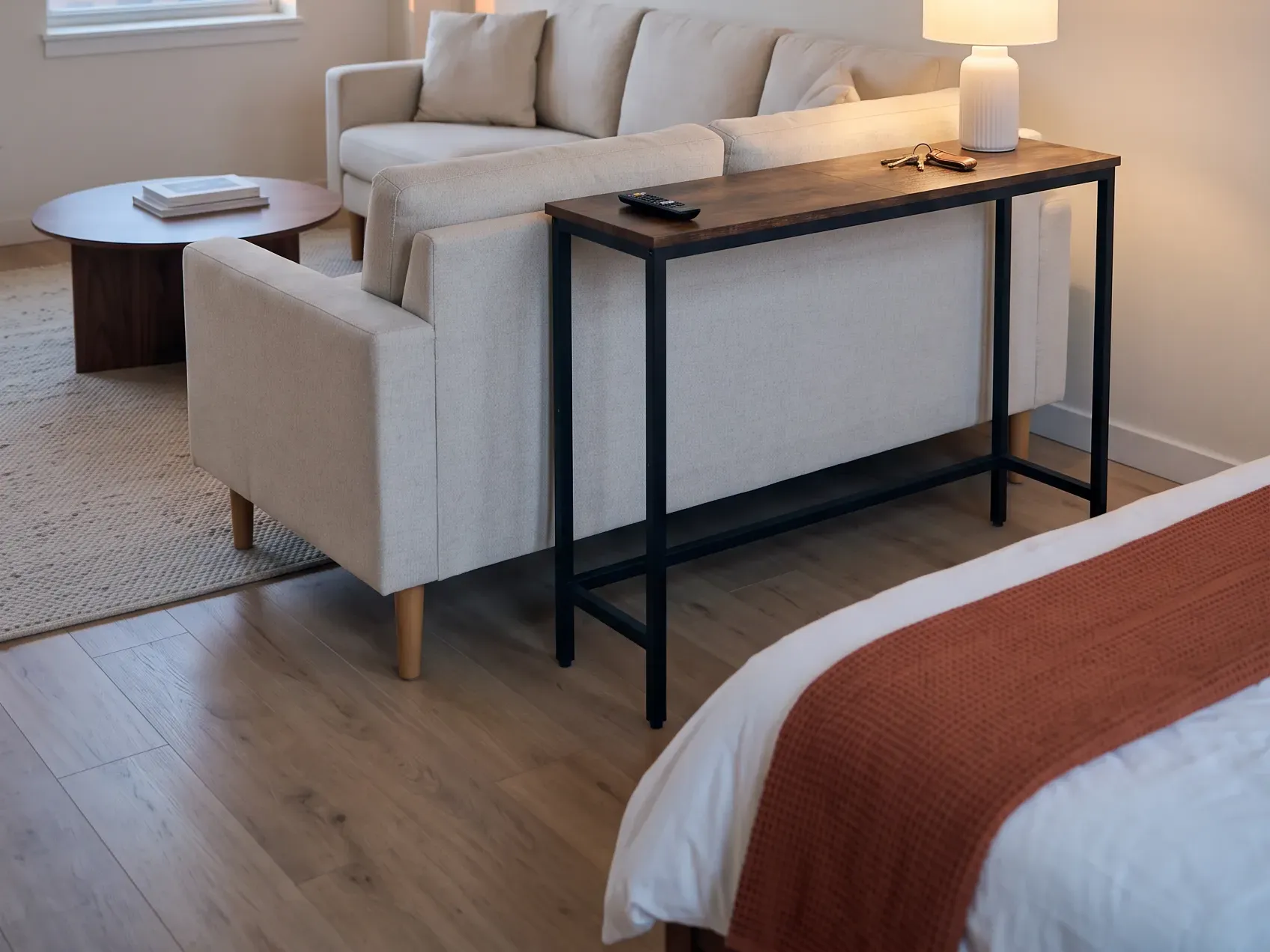
Pull the sofa away from the wall and put a narrow table behind it. The table's back becomes the edge of your living room, and the sofa finally has something behind it.
This is the move that surprises people in a studio, because the instinct is to shove everything outward for floor space. Floor space you can't define just reads as leftover room.
Doesn't that waste space? It gains you some. The strip behind the sofa was dead before. Now it holds a lamp, your keys and the charger that used to live on the floor.
- Go narrow, under a foot deep. Deeper tables turn a walkway into an obstacle.
- Match the table height to the sofa back, or come in just under it. Taller looks like a mistake.
- It does not have to run the full width of the sofa. A short table centred behind it still draws the line, and leaves room to walk past at both ends.
How far out should the sofa sit? Far enough to walk behind, so about two feet from the wall once the table's in. If that's more than your floor can spare, angle the sofa across a corner instead and let the table follow the angle.
Our picks
Similar finds on Amazon
Where do you work in a studio apartment with no room for a desk?
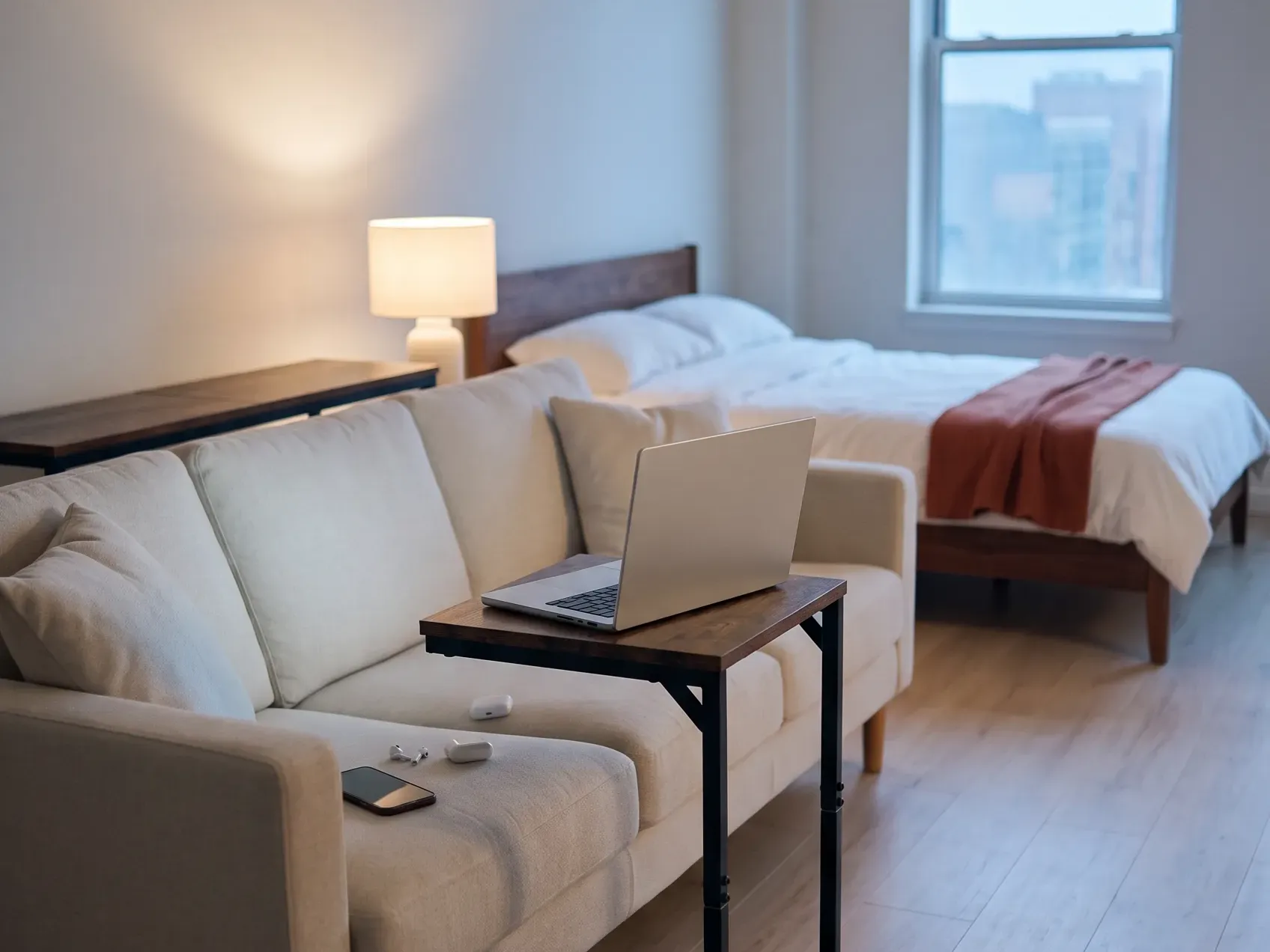
Use a C-shaped table that slides over the sofa or the bed, so the work surface arrives when you need it and disappears when you don't. A full desk in a studio costs you a zone you would rather use for living.
The base slips underneath the furniture and the top hovers over your lap. It's the only work surface worth recommending to someone whose living room and office are the same nine feet of floor.
Is it really enough for a laptop day? For a laptop, yes. For two monitors, no. A studio will not hold that setup comfortably, and pretending otherwise costs you the living zone.
- Park it at the sofa arm in the evening so it doubles as a drinks table.
- Slide it to the bed side in the morning if you work propped up.
- Run the charger along the back of the sofa to the nearest socket, so no cable crosses the open floor.
That last one matters more than it sounds. A cable crossing a room erases the boundary you just spent a weekend building.
What about the end of the workday? Give yourself a shutdown move. Slide the table back, stow the laptop, and the work zone stops existing until morning. You can't walk away from your desk in a studio, so the desk has to walk away from you.
Our picks
Similar finds on Amazon
What do you do about clothes when a studio has no closet?
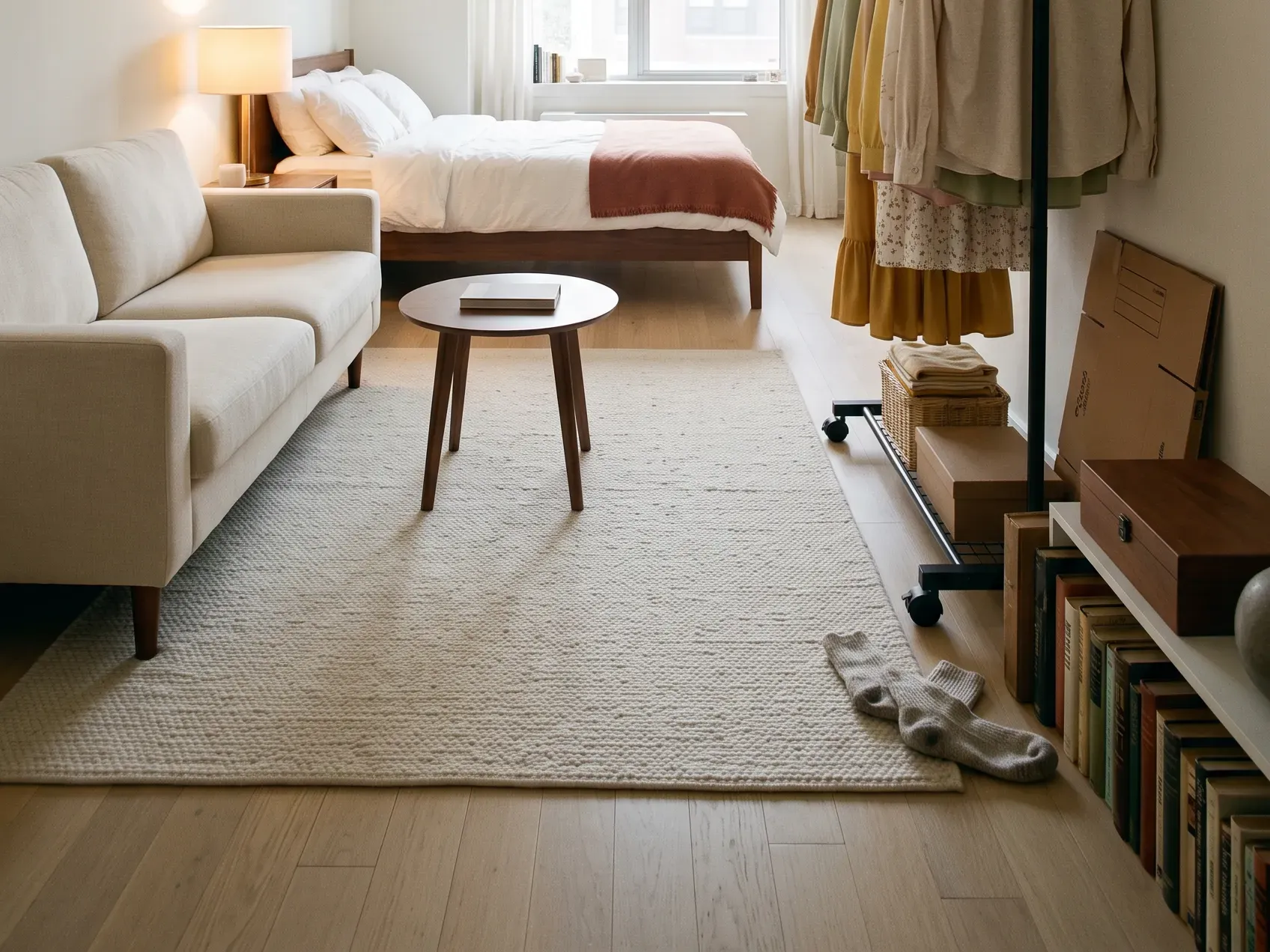
Give the clothes their own corner with a freestanding rack, and treat that corner as a fourth zone rather than an overflow pile. Studios usually come with one shallow closet or none at all.
An open rack looks better than people expect, on one condition: what hangs on it has to be worth looking at. This is a zone you can see from the sofa, so it's on display whether you planned that or not.
Won't it look messy? Only if you hang everything. Keep the rack to one season and one palette, and put the rest in the containers under the bed.
- Casters matter in a studio. You'll want to roll it out to vacuum and roll it back.
- A mesh shelf underneath takes shoes and folded knits, which keeps the floor around it clear.
- Stand it against the shortest wall, not the one you see first walking in.
Can the rack double as a divider? It can, and that's two jobs from one purchase. Turn it side-on so the clothes face your dressing corner and the back faces the sofa. You get a soft wall of fabric, which also takes the echo out of hard floors.
Our picks
Similar finds on Amazon
Where does everything else go in a studio apartment?
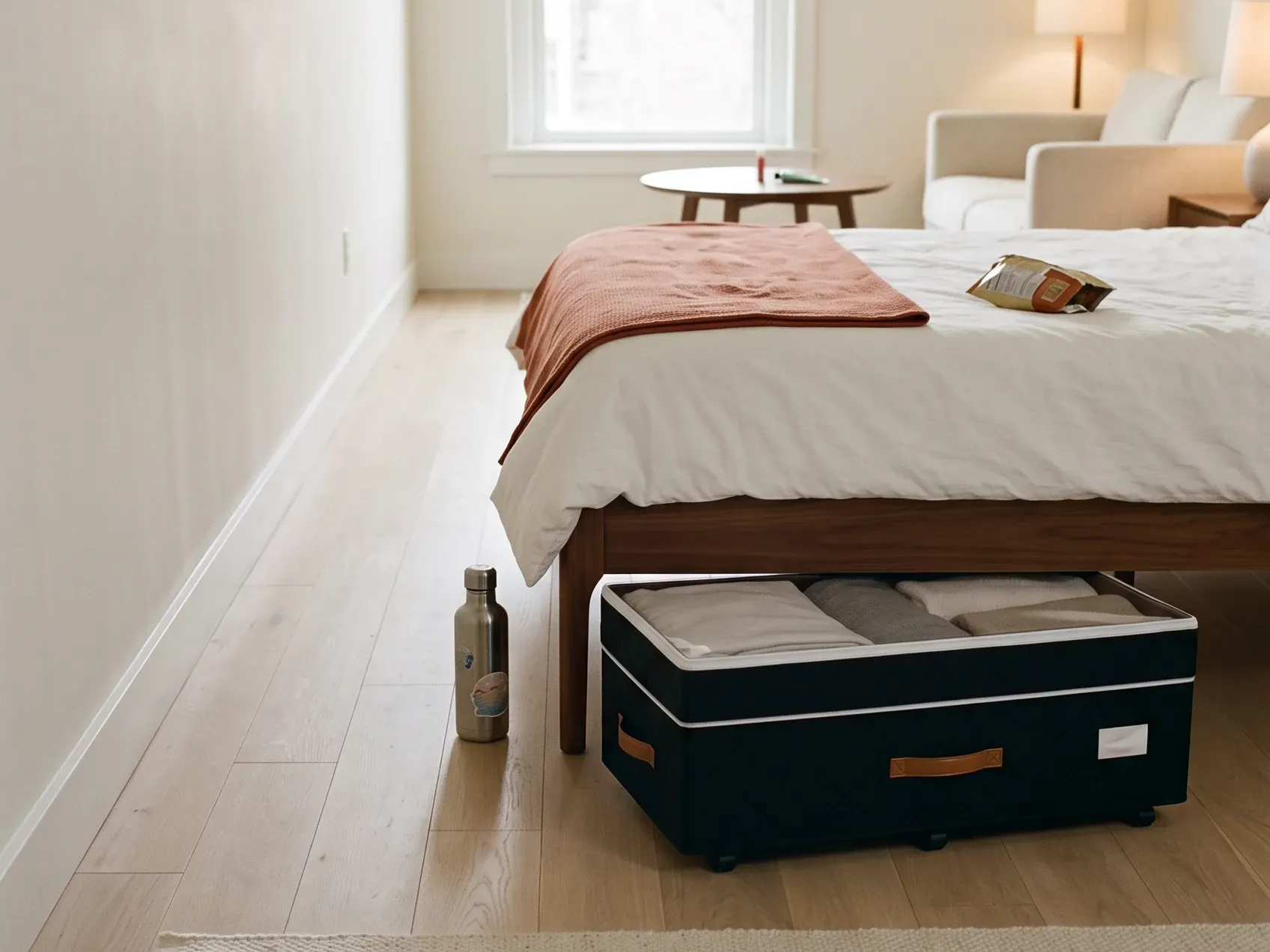
Under the bed, in containers on wheels, sorted by how often you open them. It's the largest unused volume in a studio and most of it gets wasted on soft bags that collapse and get shoved out of reach.
Wheels are the difference between storage you use and storage you forget. If getting to the winter coats means lying on the floor and dragging, those coats are gone until spring.
- Measure the gap under the bed frame first, and take an inch off for the wheels.
- Put the things you touch weekly in the container nearest the walkable side.
- Keep one container half empty on purpose, for the clutter that appears before guests arrive.
Should you raise the bed to fit more? Only if you're confident about the frame. A studio bed is also seating, and a bed you have to climb into stops feeling like a sofa.
What shouldn't go under there? Anything you need in a hurry, and anything that minds dust. Air moves less down there than you think, so keep rotating bedding in a lidded container, and leave medicine and chargers somewhere you can reach standing up.
Our picks
Similar finds on Amazon
How do you stop the zones from making the room feel smaller?
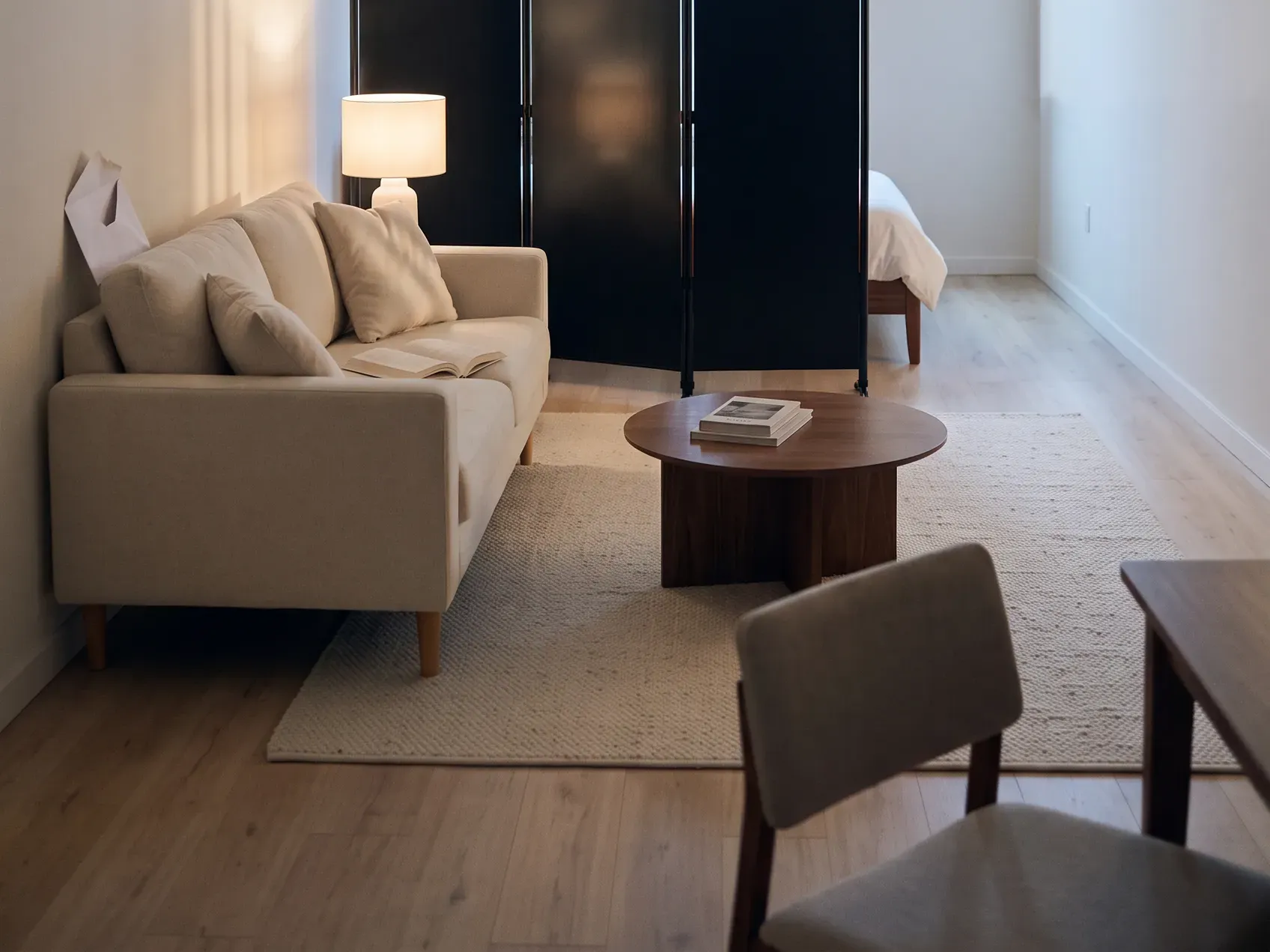
Keep one long sightline open, usually the one from your front door to the window. Zones work as long as they interrupt the room sideways rather than blocking it end to end.
This is where most studio layouts go wrong. Someone gets excited about dividing, puts the screen dead centre, and turns one airy room into two cramped ones.
- Stand in your doorway before you commit. If you can't see a window from there, move something.
- Keep boundaries low or see-through on the side nearest the door, and save the solid screen for the far end by the bed.
- Stop at three zones. A studio can hold three edges before it starts feeling like a storage unit.
- Repeat one material across the zones (the same wood tone, the same black metal) so the room still reads as one place.
Does a rug help? It draws an edge without standing up in the room at all. Put one under the sofa and your eye reads the living zone as ending where the wool does. In a studio that's the only boundary that costs you no height.
What about a mirror? Worth it here, more than in any other room. Lean a tall one on the wall opposite your window and the reflected light reads as a second window, which buys back some of the openness the dividers cost you.
If you're renting, the rest of the damage-free playbook is in no drill wall decor, and the softening layer is in cozy living room ideas.
Our picks
Similar finds on Amazon
The bed is what makes a studio read as a bedroom all day long. So the edge between it and your sofa is the one worth sorting before anything else here, and once your eye has somewhere to stop, the rest of the room gets easier on its own.
Three zones out of one room, and not a single hole in a wall. On moving day it folds, rolls and lifts into a car.
That last part isn't the compromise you make for renting. In a studio it's the reason any of this works.